The authentic and timeless world of Ralph Lauren
November 2025
RL/Men

A Coat With Character

Looking for a coat that lets you look rakish and refined? The balmacaan is for you.
By Michael Hainey
Every coat has character—that’s why the trench will always be Humphrey Bogart and Albert Camus. But for my money, the coat with the richest character—and the one that makes every guy look more like the artist he aspires to be—is the balmacaan. I first saw one in person my freshman year of college. This was in the ’80s, back in the Midwest, and the guy wearing it was from (where else?) the East Coast, a place where they embraced classic pieces. As he walked across the quad, I was mesmerized by the silhouette he cut in it; he looked mythic and bold and rebellious. I’d seen the balmacaan before—and to be honest, at the time I didn’t even know the coat had an official name—but I’d never seen one in person, only in photographs of British rockers in music magazines or American authors on their book jackets. And in those days, it seemed like so many of the writers and musicians I admired (and aspired to have the style of) had made the balmacaan their official coat of choice. There they were, walking through New York City’s then-deserted streets, cloaked in the thick wool of the coat, that substantial collar popped high against brisk winds coming off the Hudson. Or there they were, standing on some grey moor, looking defiant and confident, as the generous cut of the coat flowed around them. I’ll just go ahead and say it: In those coats, all these guys looked rugged, yet at the same time they had a flair of romance about them.
Those traits are no surprise. From the time the coat was created back in the 1800s, reportedly at the Balmacaan Estate in Scotland, it’s had ruggedness and romance woven into it. Because it was made to be worn while hunting or fishing, it was cut in fuller in the body as well as in the shoulders, creating a more relaxed fit that glides over a sport coat and allows a man to cast a reel, shoulder a shotgun, (or hail a cab). Yet because it was made by the Scots, it was made from those unbeatable Scottish fabrics that stand up to the elements yet are also woven to look beautiful. Today, you can recognize a balmacaan through two important details: First, the stand-up collar that is high in the back and low in the front and can be fastened close to the neck. Second, the raglan sleeve, which is different from a more structured topcoat. Those are the technical ways to recognize it. But the real way to recognize it is this: Next time you see a guy cutting a rakish profile, chances are he’ll be in a balmacaan. And you should be, too.
Bryson Leather Cap-Toe Boot
C$298.00
The Iconic Cable-Knit Cashmere Sweater
C$648.00
Heritage Round Sunglasses
C$315.00
Slub Denim Western Shirt
C$198.00
Wool Flannel Trouser
C$528.00
Maestra Tassel Calfskin Loafer
C$798.00
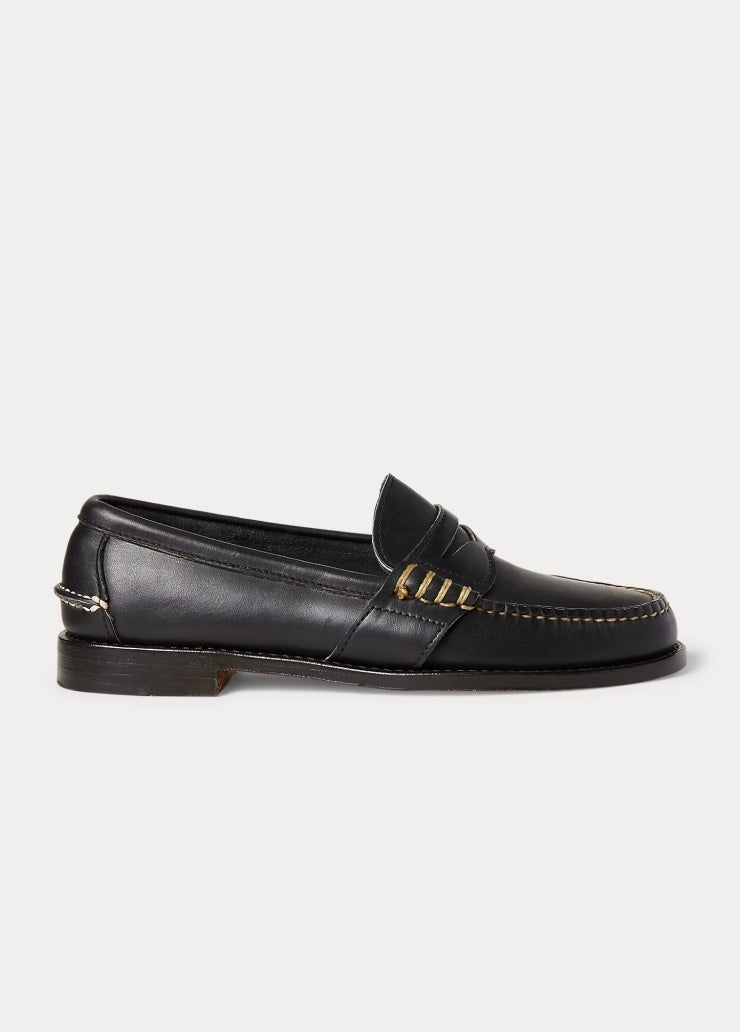
Edric Leather Penny Loafer
C$398.00
Heritage Rowing Stripe Round Sunglasses
C$260.00
Sullivan Slim Garment-Dyed Stretch Jean
C$268.00
Custom Fit French Cuff Tuxedo Shirt
C$228.00
Knit Silk Tie
C$125.00

Michael Hainey, a writer at large at Air Mail, is the author of The New York Times best-selling memoir, After Visiting Friends.

Dream Weavers
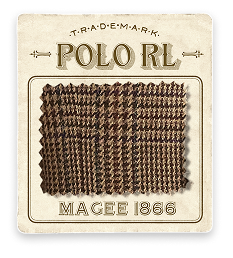
Meet the historic mills in the British Isles that have supplied Polo with exclusive and choice tweeds since the very beginning.
-Eric Twardzik
Tweed is a word rich in evocations, conjuring country houses, outdoor pursuits, and most of all the hard-wearing fabric itself, which is both rugged and refined, rustic yet elegant. These qualities have made it a staple in Polo collections for more than 50 years, during which time Ralph has built personal and long-lasting relationships with some of the finest independent mills that continue the old traditions of weaving in the place of this iconic fabric’s birth, the British Isles. Over the decades, Polo has curated a veritable library of tweeds—a trove of exclusive patterns that may change in scale or saturation from season to season but rarely repeat. This fall is no exception, bringing together belted balmacaan coats, three-piece suits, and new expressions of our iconic RL67 jacket in tweeds Ralph himself has tweaked to his liking.

A valued partner from the earliest days of the company, Magee 1866 is a fifth-generation family-owned mill located in Donegal, Ireland—a town that uncoincidentally shares its name with a specific type of flecked pattern. In true Donegal tweed tradition, Magee’s creations have a hardiness suited to Northwest Ireland’s windswept shores yet feel soft and spongey to the hand, a quality that lends itself to our balmacaan coats. Among the proprietary tweeds it mills for Polo is also a blend of lambswool and alpaca that achieves an unparalleled depth of color and texture, used this fall in a brown herringbone RL67 jacket with a matching vest.

Situated in the Scottish Borders, Lovat’s creations are a reflection of its rural surroundings, expressed in rich, earthy hues that have made Lovat a famous name among tweed connoisseurs. For this season, we mined the mill’s substantial archives, where we found a houndstooth tweed from the 1920s that the mill recolored and revived as a three-piece suit, reinterpreting a piece of Lovat’s history though a distinctly Polo lens.

Founded in 1863 in West Yorkshire—the traditional hub of British textile manufacturing—Mallalieus is among the few independent mills still weaving in England. A specialist in tweeds, it is also notable for being a fully vertical mill, taking raw wool fibers that are then dyed, carded, and spun into yarn on-site before the weaving process has even begun. For this fall, we tapped Mallalieus to create a gun check tweed in a tea-stained shade of brown that has been tailored into a sporting jacket with a matching vest.