The authentic and timeless world of Ralph Lauren
December 2025
RL/Culture

Melon Fever

For one writer, there’s nothing better than this half-century-old jewel box, which happened to make an appearance in one of this fall’s photoshoots for Polo.
By Eric Twardzik
Restaurants have changed a great deal in the last 50 years, and not always for the better. Interiors and menus that seem generated for algorithms rather than patrons, the increasing influence of delivery apps, and—god help us—QR codes. Happily, none of the above are a factor at what’s long been my favorite New York restaurant, J.G. Melon, which doesn’t even take credit cards (there’s an ATM across the street that seems to exist for this very purpose). It has sat at the northeast corner of Third Avenue and East 74th Street since its founding by Jack O'Neill and George Mourges—hence, “J.G.”—in 1972 and seems to have not progressed forward a single moment in time since, even as the city that sustains it barrels forward at a breakneck clip. It’s a place where traditions endure and taste still matters.
The bartender slapped a JG Melon fridge magnet on the bar and said “Welcome to New York.”

Indeed, this permanence is a key part of its appeal. From the moment you spy its hunter-green brick exterior and the T-shaped neon sign glowing like a warm, welcoming beacon on a cold night you know you’re going to be in trusting hands. Like any great place in New York, it has its rituals, too. You’ll enter a comically small anteroom, often packed with other hopeful diners, and are quickly sized up by a host who can quote you a wait time for one of its little tables covered in green-and-white gingham, or invite you to join the scrum for a stool at its dark wooden bar. Whatever your path—I’m always one for a barstool—your destination is the same. A juicy, utterly unpretentious burger seared on a flat-top grill just feet from the bar, and yours for less than $20 in the year 2025. The toasted white bun is squishy, not brioche; the loosely packed beef is not Wagyu, but a special blend sourced from Bronx butcher Master Purveyor; and the word “aioli” would never be spoken aloud. Toppings begin—and end—at bread-and-butter pickles and a ring of raw onion. If you’re feeling adventurous, the spiciest addition you can make are a few crispy strips of bacon. Its companion, the venue’s beloved “cottage fries,” are simply crinkled potatoes cut to the rough shape and size of a Kennedy half-dollar. Their temporary absence in 2021 stemming from supply chain issues sent shockwaves through the Upper East Side.

GET THE LOOK

FALL’S NEW STYLE NOTES

Sure, the days are shorter now, but that means your nights are longer. It’s the time of year when you need to be ready to roll from coffee to cocktails and then a late night burger at J.G. Melon’s with the guys. And with a range of new fall pieces, we have you covered with the season's best looks, fits, and options. Read Now
Playing feuding spouses, Hoffman and Streep have a blow-up at Melon's in the 1979 drama Kramer vs. Kramer.
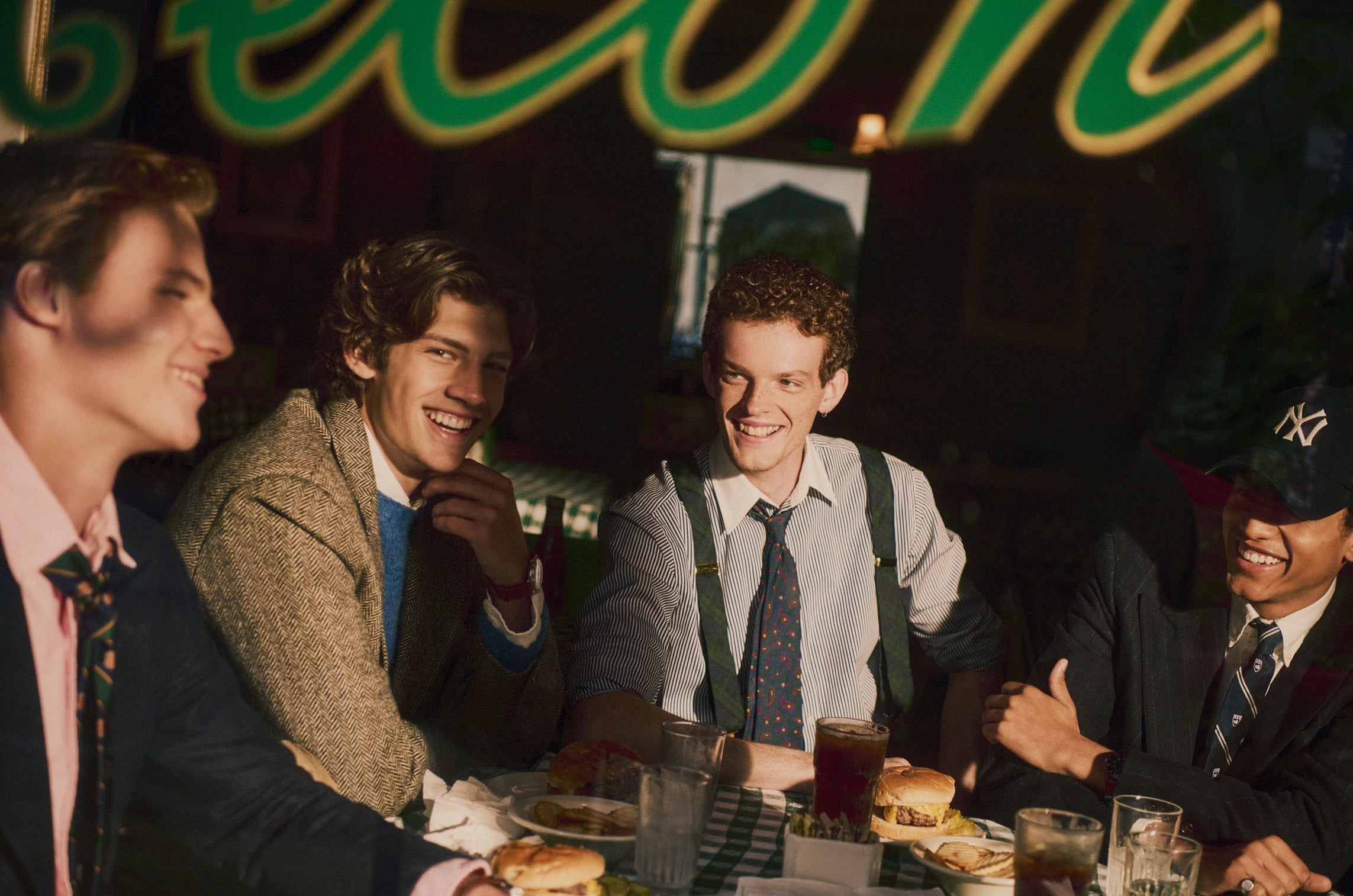
There are other items on the menu, which was hand-painted on a wall facing the front door in 1972 and has changed little since. Once in a blue moon you might see a confused out-of-towner nursing a turkey club, and I even observed a man working over a large sirloin steak at the bar around 1am. But the burger remains supreme. That isn’t to say that it’s the only draw. For me the fatty, salty—and thanks to its vegetable toppings, crunchy and acidic—package cries out for the bracing cleanse of a dry gin martini whipped with vigor in metal shakers and poured large by often-aged bartenders with outstanding vigor. I often credit Melon’s for convincing me, previously a stirred-only snob, that a frothy martini covered with a light layer of ice crystals can be a beautiful thing in a bustling New York barroom, particularly in summertime. Not that the bartender sold me on it in those words —I just knew it was better to trust his wisdom than to pipe up when I saw the shaker come out. Indeed, the perpetually slammed bar staff in their white shirts rolled to the sleeves and watermelon club ties seem formidable at first, but their gruff demeanors conceal a warm hospitality. When I lived in New York for a summer some years ago, I visited Melon’s on my first night and told the bartender that I’d just moved to the neighborhood; in response, he slapped a J.G. Melon fridge magnet on the bar top and said “Welcome to New York.” And while I never quite became a regular myself, those that qualify are often greeted upon their entry with questions about how the kids are doing or if they got up to Maine for the summer.
It's always a delight to witness someone's face as they walk through the front door for first-time.

I’ve taken friends to Melon’s—it’s always a delight to witness someone’s face as they walk through the front door for the first-time, their eyes first adjusting to the light and then, growing wide with wonder when they see the jewel box they’ve entered—but it’s among the dying breed of restaurants where it also feels totally fine to be alone. Having eaten solo at its bar more times than not, I’ve found that my usual instinct to stare into my phone negated, at least temporarily. Part of that, surely, is the décor: melons appear in every possible form—sketched, painted, carved—along its jam-packed walls, and naturally attract the eye (unless the bar’s lone TV happens to be tuned to a particularly nail-biting Yankees or Knicks game). While still family-owned, Melon’s is anything but a secret. Among its early high-profile endorsements was an appearance in Lisa Birnbach’s 1980 The Official Preppy Handbook, where it was listed in a city-by-city guide of “Where the Preps Are.” In the decades since it’s earned praise from such regulars as Jerry Seinfeld and Michael Bloomberg, and was named the best burger in New York by Gigi Hadid during a Tonight Show appearance. The restaurant itself has appeared on-screen a number of times. It was the setting for a tense meeting between Dustin Hoffman and Meryl Streep’s characters in the 1979 divorce drama Kramer vs. Kramer, and it pops up as an exterior shot (permission was not granted to shoot inside) in Metropolitan, Whit Stillman’s 1990 comedy playing on the ennui of Manhattan debutantes in a changing world. It goes without saying that the J.G. Melon captured in both instances has—now decades later—still not changed one lick, quite a feat in a city that itself never stays the same.

ERIC TWARDZIK is a writer with a deep reverence for things that get better with age, from tweed jackets to single-malt Scotch. He has contributed to titles including GQ, Esquire, and Condé Nast Traveler and serves as deputy editor of Wm Brown magazine. He lives in New England with his family and owns too many ties.